One small change can shed kilos

I used to think that one tiny change would never result in the loss of the fifteen kilos that I wanted to shed. To lose that kind of weight, a change had to be dramatic, drastic, and most of all, tortuous.

Medical research is showing that is not the case at all. They examined the world’s fattest man, and to reach his astronomical weight, all you have to do is eat 300 calories more than you need, every day, for about twenty years. He was so large that they had to take him to hospital on a forklift truck. So basically, all you need to do, to become enormously fat, is to eat one Mars Bar too many, every day. Gosh, I thought. That’s so easy to do! I could easily eat a small bar of chocolate more than I need every day. And some days, I could eat several.

Luckily, the reverse is also true.

If you reduce you calories a little bit every day, even if only by 50, you will lose weight. That’s just one biscuit. If you eat one biscuit less, every day, over the course of a year, you’ll lose weight. About five pounds or two kilograms, to be exact.

Excerpt from ‘Why we Cheat when we Eat and how to stop’.
How did the packet end up empty? Part 2

Not only is this embarrassing. It’s extraordinary. It seems that our left hand literally doesn’t know what the right hand is doing.

The first thing to do, is not to add to your woes with a large helping of guilt. These are well worn paths that you are travelling. Part of your being is just doing what it thinks you want.

David Kessler, the former head of the US government’s most powerful food agency, the FDA, talks of ‘priming’. Sometimes just one taste of a food, a single bite, is enough to trigger conditioned ‘hyper-eating’. Priming involves stimulating areas of your brain. The use of the word ‘conditioned’ means it’s already a habit. Your body recognises the primer, or taste, as the beginning of a conditioned or habituated pattern of behaviour.

The problem is that it’s hard to shut those habits off. Once primed, they stay activated and you may continue to eat until all the food is gone. That’s what the food industry knows when it tells us “Bet you can’t eat just one.”

The good news is that priming only holds power for a short time. If you eat one piece of candy and there’s a bowl of them in front of you, chances are you will keep eating more. But if no more are available or you have to search for them, the priming response may be undermined.

If you travel these paths less, or stop doing the behaviour, the priming will fade and it will stop being automatic, and you will not feel so compelled. But how to get there?

It’s easiest to stop the habit in the earliest stages. If you know there are times when you eat unconsciously, and they are usually in a certain place, or preceded by a certain thing, then try to address the first step.

What do you need to do to arrest the behaviour? To wake yourself up before your subconscious takes over?

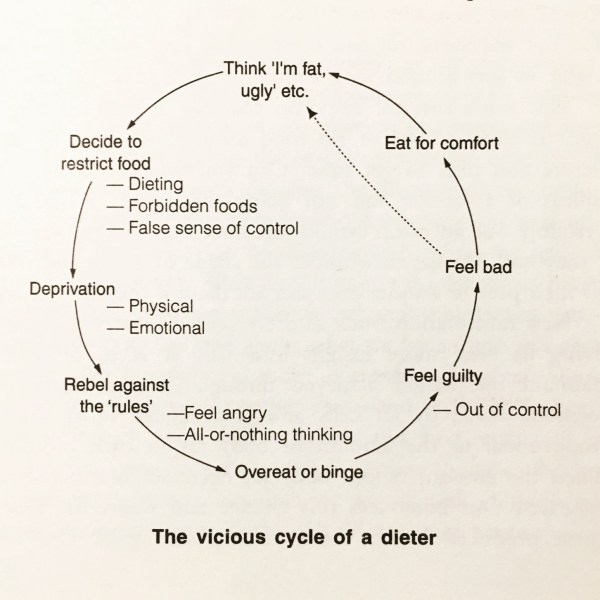
How did the packet end up empty?

Have you ever driven home from work, pulled into your driveway, and realised that you have absolutely no memory whatsoever of the journey? Perhaps you commute to work, and you find yourself at your desk, with minimal or no recollection of the various trains or buses you took.

When behaviours become habitual, or regular, our brains relegate them to the subconscious. We don’t need to focus on them, so the brain allows our consciousness to focus on something else: our phone, our worries, our plans.

Unfortunately, this same mechanism can come into play when we have regular eating habits or addictions.

The brain is used to us thinking: “Hmm, that was a stressful day. I really could use some … (insert ‘comfort food of choice’)…” And it knows exactly how to get us to the shop to buy some, and get the food into our bags and then into our mouths.

Many people have told me that they have believed that they were sticking rigorously to their diet, only to find themselves sitting on their couch with an empty food packet on their lap, and no idea of how it happened.

One of my first clients was a Mum called Maureen. She would insist that she ate without realising it. “I opened the packet, it was a packet of granola. I buy it for my kids, I don’t eat it, it’s too fattening. But I just wanted one of those banana chips, so I opened it to find one of those. There was one at the top, and I ate it. I recall delving back into the bag for a particularly large clump with a sultana in it. And the next thing I knew, fifteen minutes or more had passed, and the bag was half empty. I honestly don’t remember doing it!”

The brain has well-worn paths. It is used to a flood of sugar at certain points in the day, and can turn off your consciousness while your preprogrammed behaviour runs, acquiring the substance, and then ingesting it, all without realising it.

I have, in the past, sworn off sugar, only to have a friend point out the chocolate I was shovelling into my mouth from the bowl on her table. It was in front of me, and my hand reached for it, bypassing all my declarations that I was never going to eat it again. A tad embarrassing.

In my next post, we’ll talk about how to deal with this.

When Food is Love…

Some foods can feel like love. They fill us, soothe us, comfort us. They are there for us after a hard day, no matter what. A few mouthfuls later and a sensation of bliss flows through our bodies. It can feel as safe and nurturing as a mother’s embrace, as sublime as a lover’s kiss.

Often, these are foods we have learned to crave since childhood. Strong memories and associations underpin some of the meanings they hold for us. Somewhere in the past we have had experiences where we made a connection between the food and the emotions.

A friend told me: “I’m going home and I just know that Mum is going to ply me with cake. She’ll have baked just for me, and I both want to gorge myself on it, and want to refuse it. Because I’ll feel crap the next day.”

Who wouldn’t want to gorge themselves on their mother’s love? To feel replete with worthiness, safe as a fluffy chick in a nest.

But food isn’t love. And cake isn’t worthiness.

They can feel similar physically, which is part of the mix-up. Both trigger dopamine, and can release endorphins and other chemicals that do indeed make us ‘feel better’. We have a physiological response both to hugs and love, and to certain foods, and that response in our body is close enough for us to get confused. In fact, it not only gets us confused, it can make us rely on  one when the other (usually love) isn’t available, or doesn’t feel like it is.

One of the first things we can do is to recognise that we have conflated the two, confused ourselves by mixing love into the pie.

Then, if we find ourselves turning to food, when what we really want is love, we need to ask what else might serve in its place? Would curling up under a blanket do it? Or walking in nature? Do you need to be with a friend, even if its on the other end of the phone? Or can you bear to be with yourself, take your need for love and treasure it, and love that need in yourself enough that all thoughts of cake fade away?


Struggling to eat healthily on a budget?

This article in The Guardian describes a weekly shop for £20 (US$26 or AU$36) together with recipes that look delicious. In a bid to reduce food waste, and therefore help our environment, the inventive meals mean that nothing is thrown away.

There are pancakes and porridge for breakfast followed an enticing pasta dish with pesto and vegetables for lunch.

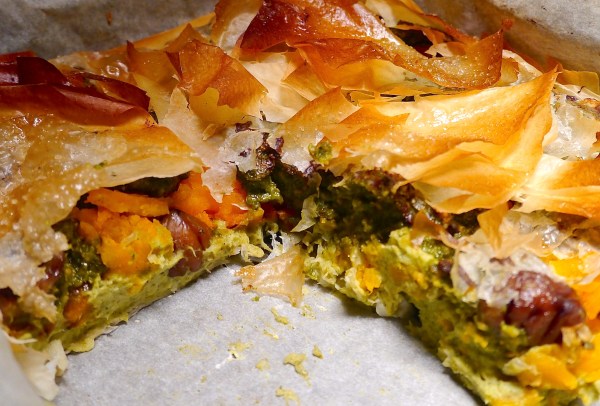
Dinner is a spectacular vegetable dish.

I love the way this looks after the planet, our wallets and our waistlines. Very few ways of eating balance all three. The Paleo and low carb diets are very hard on the environment, as eating meat is the single most detrimental thing any of us do. If you’re interested you can read more here. Supplements and shakes and pre-prepared foods are expensive.

And here is a simple way to look after all three.

Need inspiration? Check out the article.

Should I avoid carbs in the evening?

Some of us try to avoid carbohydrates in the evening, in the hope that it will help us lose weight. We’re told that we’re going to sleep soon, so anything we eat later in the day will just be stored as fat. If we want to eat carbohydrates, then we should eat them earlier, for breakfast, when we are going to burn them off.

Is this true?

The body doesn’t really work like that. If you eat more than you need on any given day, it will be stored as fat, whether it’s carbs you’ve eaten, or fat or even protein. Consume more calories than you’re burning and your body will store it. And it will store it as fat, even if you eat it all at breakfast.

Basically, your body works on physics. It’s a ‘closed system’ and the energy that goes in (food and drink) will be either stored as mass (fat or muscle) or burned as energy (either metabolic processes or exercise).

If you are training hard, are eating a set number of calories and have all of your ‘macros’ down pat (ie the proportions of fat, protein and carbs), then the timing of the carbs might make a small difference. But lets face it, very few of us are doing that.

What matters most to our bodies is calories. Clearly, a more nutrient-dense option is going to be better for our health (brown bread over white). However, if you really want carbs in the evening, then going without is probably going to lead to overeating later.

I really enjoy carbs in the evening. They help the brain release Serotonin, which is a relaxant and anti-depressant. They help me sleep. And I like a bigger meal then. It suits me and if it’s your preference too, then there is no reason not to have it.

What does suit you? Do you like carbs at night?

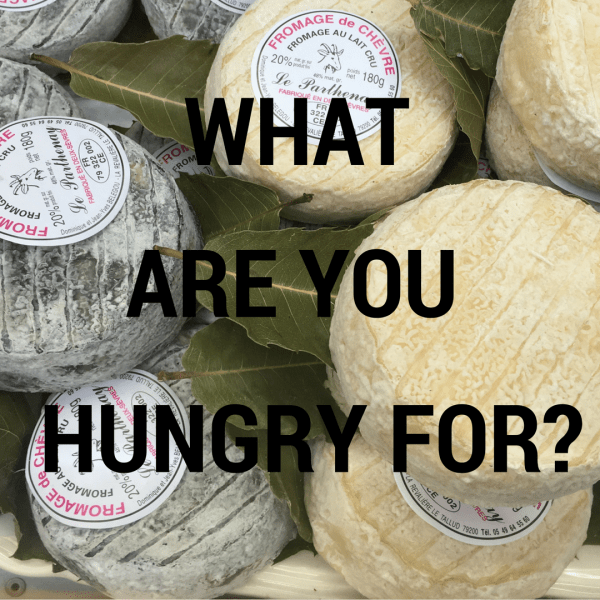
What are you hungry for?

What are you hungry for? Are you hungry at all?

Perhaps you’re not hungry, but neither are you satisfied with what you’ve eaten – you ate a salad when you wanted something hot and filling, believing that the salad would be ‘better for you’. And instead, all you want to do is eat more.

Perhaps you are scared of feeling hungry, and don’t dare let yourself feel it? In case the hunger is so great that you eat everything in sight…

Or is it sugar craving driving you, not hunger at all? A roller coaster ride of insulin and glucose: sedated on carbs one minute and desperate for another fix the next.

Maybe you’re actually hungry for recognition, or a new job, or a bit of encouragement. But that isn’t forthcoming, so a biscuit will have to do.

It can be worthwhile to sit for a moment, and to allow quietness to settle into your limbs, so that you can ask your stomach, your heart, your being: what am I hungry for?

And then give yourself permission to have it.

How to get over the fear of feeling hungry

For a long while I was scared of feeling hungry.

“I’ll just have a snack now in case the meeting runs late.” “I’ll eat something to get me through the school run”. “I’m going out to dinner, and I don’t want to get hungry, so I’ll eat something now”

In fact, there was a time when I was so scared of feeling hungry that I hadn’t felt hungry for years. I never let myself get to that point.

At the very first sign that I might get a hunger pang, I’d tuck into something. At the thought that I hadn’t eaten for a few hours, I’d open a packet. If I began to realise that there may be a gap between meals – I’d ensure there wasn’t.

And it has taken me a long time to get over that fear.

A review of the (more honest) comments of Hollywood actresses, reveals that many of them admit to feeling hungry all the time. This is the only way they can maintain their abnormally thin frames. Feeling hungry all the time is very draining and exhausting.

But that is very different to feeling hungry for half an hour.

It is absolutely worth letting yourself feel hungry. When you eat, the food tastes better. There is a real sense of the body refuelling. It’s a true sign that you need to eat.

But first of all you need to know what hunger feels like, and that may take a while.

The basics of weight loss for life

The basics to weight loss and weight management are really very simple:

You get hungry

You decide what you’d really like to eat

You enjoy your food, savouring every mouthful

You stop eating when you are no longer hungry

Repeat until death

But somehow we seem to have made this incredible simple process very difficult.  Over the years we are told what to eat, when to eat, where to eat, until you eat when you are told, not when you are hungry, you eat what is prescribed or ‘allowed’ not what you’d really like to, and as for stopping?  Isn’t is when the plate is empty?  Or when the serving bowl is empty?  Or worst of all, when the fridge is empty of all its temptations….?

Hmmm, there were many years when I actually thought I had been born without the stop button.

Listening to what we are told, rather than our bodies, means that we over-ride our natural mechanisms for hunger and satiety.  We no longer recognize when we need to eat (or when we don’t) and we no longer recognize when we should stop eating.  This means we eat long past the point of fullness.  It means we eat when our bodies are not hungry or ready for food.  It means we eat when we already have sufficient energy to live so it means what we eat is laid down as fat.

Eating in tune with your body is a very satisfying thing.  Your body does not want to be overweight, or heavy.  It wants to be lean and energetic.  This is how it was made to be.  But years of over-feeding, starving, fast food, Christmas and Thanksgiving and diets have beaten it into submission.  Now it just opens its mouth and digests whatever you next put into it.

But if you start listening to it again, it will actually talk to you.  It will tell you when it is hungry and when it is not.  It will tell you when it needs some red meat for iron or when it craves the vitamin C in citrus.

Blog at WordPress.com.

Up ↑